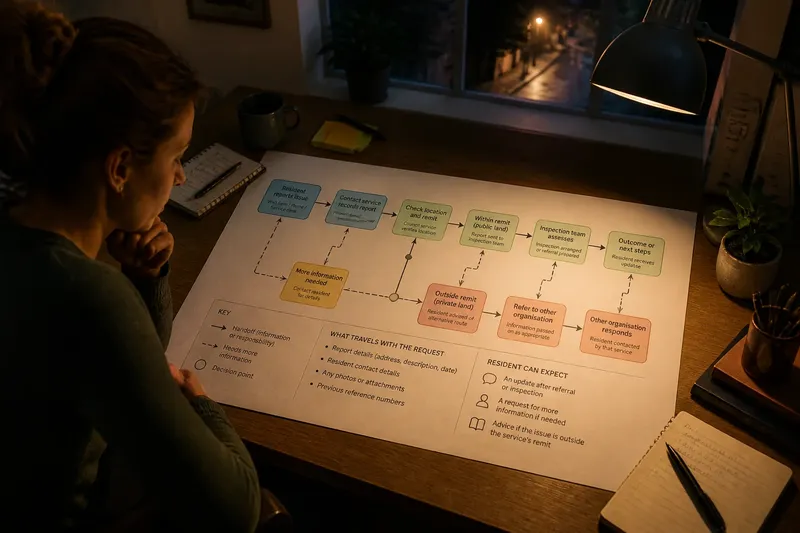
Council, Committee, Officer: Who Does What?
Council, committee, and officer roles can blur in public papers. Trace who discusses, recommends, decides, and carries out a proposal before you respond.

Who actually decides whether a local proposal goes ahead? To understand council, committee, and officer roles, start with the paper or meeting notice in front of you and trace the proposal through each stage. The names of bodies can sound decisive, but the useful clues are the verbs: discuss, recommend, approve, instruct, deliver.
This matters when you want to know what residents can still influence, who must answer a question, or why a decision appears in one place and action in another. Councils organize authority in different ways, so treat the route below as a way to read your own council’s documents, not a universal chart.
Start with the proposal and its current stage
Find the proposal’s exact name and the document that brought it to your attention. It might be a committee agenda, an officer’s report, a notice of a public meeting, or a council decision record. Note the date and the body named on the front page. Those details help distinguish a live proposal from a record of something already decided.
Look for a section called “recommendation,” “decision required,” “purpose,” or “next steps.” The wording often reveals whether the document asks a group to make a decision or simply gives it information. “Members are asked to approve” points toward a decision. “Members are asked to note” usually signals awareness, not authorization.
Also check the report’s status. A draft, an options paper, and a final decision notice do different jobs. If the status is unclear, search the council website for the proposal title and look for a later meeting record. A newer report may explain whether the issue moved forward, changed direction, or remains open.
Find the group that discusses the proposal
A committee is a group of councillors assigned to consider a particular area of council business. Depending on local arrangements, that could be a planning committee, a scrutiny committee, or a service-focused committee. Councillors debate reports, ask questions, hear representations where the rules allow, and consider possible responses.
Discussion is not automatically a decision. A committee might recommend an option to the full council, refer a matter elsewhere, request more information, or decide within authority assigned to it. Read the agenda item and the council’s published scheme of delegation, which describes who can exercise which powers.
To establish what happened in the room, read the minutes or decision record as well as the agenda. An agenda describes what was planned; minutes record what the committee did. Look for the motion or resolution, any conditions, and the body responsible for the next step. If the record says “recommend,” do not translate that into “approved.”
Separate advice from a formal recommendation
Officers are council employees who provide professional advice and manage the organization’s work. A report may be written by an officer, who can explain legal, financial, operational, or technical considerations. That does not, by itself, mean the officer has authority to approve the proposal.
Reports often contain several distinct voices. The officer’s analysis may describe options; a recommendation may state the course the officer advises; and a committee resolution may show what councillors formally decided. A recommendation is advice presented for consideration unless the council’s rules or a specific delegated power make it an authorized decision.
Check the author, report role, and decision wording. Phrases such as “The Director recommends” identify advice. “The Director has decided under delegated authority” indicates a different route, and the report should explain the power used or point to the relevant procedure. If the authority is not clear, the council’s constitution or governance pages can provide context.
Identify who has authority to decide
The decision-maker may be the full council, a committee, an executive or cabinet, a portfolio holder, or an officer using delegated authority. Arrangements vary by council and subject. A body’s name alone cannot tell you whether it has the power to make the particular decision.
Search the report for “decision,” “approval,” “delegated,” “recommendation to council,” and “subject to.” Then compare the wording with the council’s constitution or scheme of delegation. These documents describe the route of authority and may explain which matters must go to councillors and which can be handled by officers.
Watch for conditions that leave a later choice unresolved. A committee may approve a proposal in principle but ask officers to settle details; a recommendation may need full council approval; or a decision may depend on another body’s agreement. Ask which part is settled and who still has discretion. “Approved” can refer to one stage rather than every action needed to put a proposal into effect.
Trace what happens after the decision
Once authority is clear, find who is tasked with carrying out the decision. Officers commonly arrange practical work: preparing a service change, managing a contract, communicating with residents, or reporting back. The decision record may name a department, responsible officer, or follow-up report. These details show how a formal resolution connects to daily administration.
Say a council report proposes changing the hours of a neighborhood customer desk. Imagine the report says a service committee will consider options, an officer recommends revised hours, and the committee can only recommend a budget change to full council. If the committee supports the change, the next observable event is the full council’s decision record—not a notice claiming the committee has already put the new hours in place. If full council approves the budget, officers may then arrange the service changes and publish updated hours.
This invented situation shows why a proposal can pass through several hands without everyone doing the same job. The committee weighs the proposal; the officer supplies advice and later carries out authorized work; the body with budget authority makes the relevant decision. Think of a relay: each person handles a different part, and the handoff matters as much as the runner’s name.
Check the route when the documents seem to conflict
Public papers can use “council” loosely to mean the organization, while “the Council” may also refer to the elected full council. A committee’s resolution can therefore be mistaken for an organization-wide decision, or an officer’s report for a final instruction. Read the full sentence and identify the named decision-maker.
Compare the agenda, minutes, report, and decision notice rather than relying on a headline. If the documents appear inconsistent, note whether the committee decided or recommended, which authority was cited, and what action is pending. Then ask the council’s democratic services or governance team to point you to the applicable rule. For a decision with legal consequences, seek advice from a qualified professional rather than treating a general explanation as legal guidance.
- Who is named on the agenda? If it names the full council, a committee, an executive body, or an officer, follow that route; if it names only a service or gives no decision-maker, check the report or ask democratic services.
- What action is requested? If the wording says “approve,” look for a formal decision; if it says “consider” or “note,” treat it as discussion or acknowledgment unless another passage states otherwise.
- Where is the authority described? If the constitution or scheme of delegation names the relevant power, compare it with the report; if no matching power is clear, ask the governance team which rule applies.
- What does the formal record say? If minutes or a decision notice record approval, note any conditions; if they record only a recommendation, look for the later decision-making body.
- Who owns the next action? If the record names an officer, department, or body, follow its update or report; if it names no owner, ask the meeting clerk who is responsible for the follow-up.
- Is a condition still outstanding? If approval depends on a budget vote or another body’s agreement, look for that decision before treating the proposal as settled; if no condition is recorded, check the full resolution for any limits.
Use these questions to pin down responsibility
Does a committee always make the decision?
No. A committee may discuss an issue, recommend an option, or decide within authority assigned to it. The agenda wording, formal resolution, and council’s delegation rules help establish which role applies.
Can an officer make a decision?
Yes, where the council’s arrangements give that officer delegated authority for the matter. Look for the stated authority and decision record; an officer’s recommendation alone does not show that a decision has been made.
What does “for noting” mean?
It usually means the body is being asked to acknowledge information rather than approve a proposal. Check the report and minutes for any separate resolution or follow-up action before drawing a firm conclusion.
Where can I find who decided?
Start with the meeting minutes or official decision notice, then compare the result with the relevant agenda item. If the record does not identify the authority clearly, ask the council’s governance or democratic services team which rule applies.
Make your next question precise
Once you have traced the route, direct a question to the right place. Ask the committee clerk when an item is scheduled for discussion; ask the governance team where decision-making authority is set out; or ask the responsible service department about an action assigned to officers. A specific question—“Was this a recommendation to full council, or a decision under delegated authority?”—is easier to answer than “Who is responsible?”
For the next council, committee, and officer question you encounter, follow the verbs from report to resolution to delivery. That trace shows what has been debated, what has been authorized, and what remains to happen, even when the proposal moves through several parts of the institution.